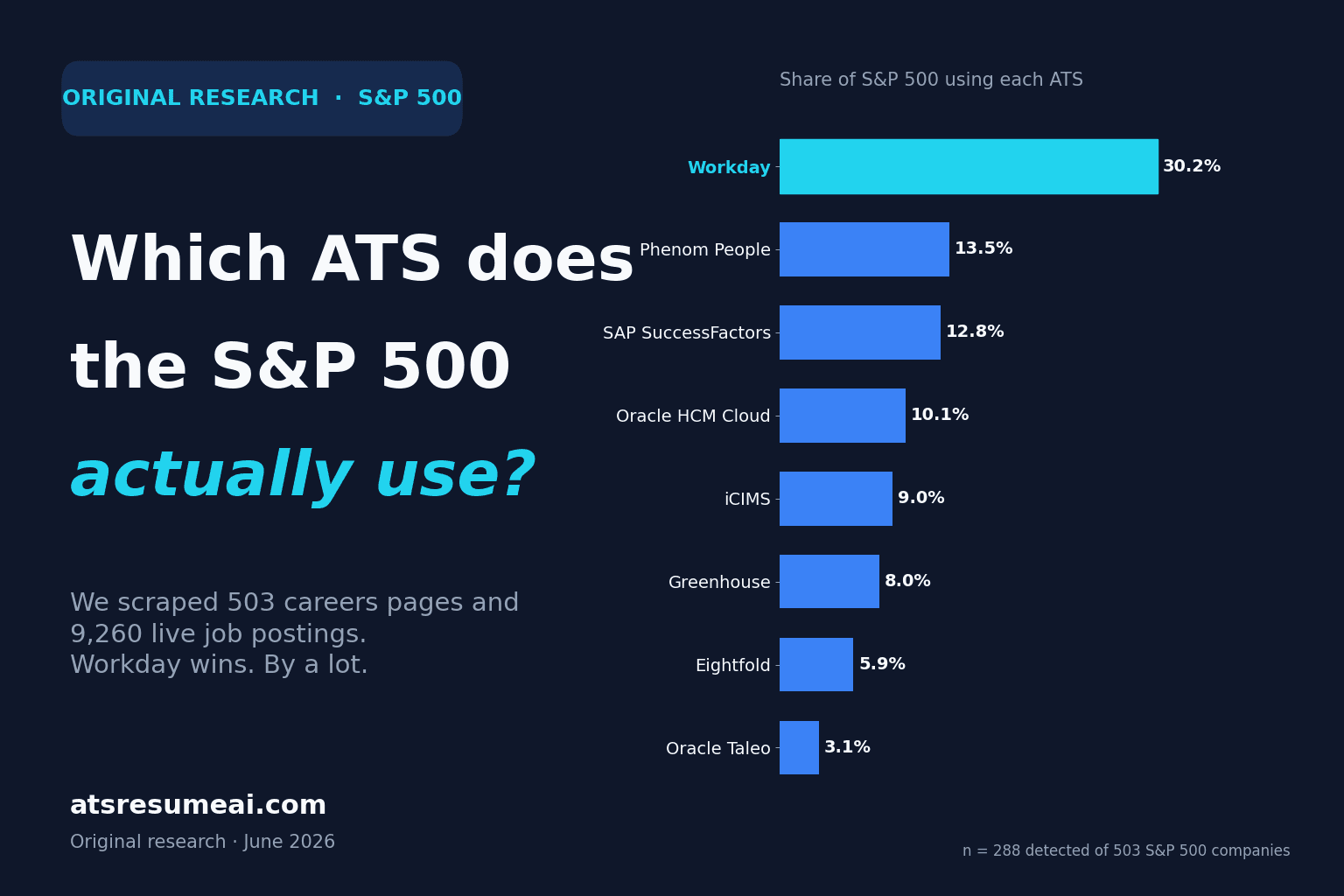
Which ATS does the S&P 500 actually use? We indexed 503 careers pages and 9,260 live job postings.
Want to act on this now? Check your resume free in our instant checker — paste your resume (and a job description) and see your ATS score plus the keywords you're missing. No signup, runs in your browser. Or look up any S&P 500 company's ATS.
If you've ever applied to a job at a Fortune-class US company, your resume has been parsed by an Applicant Tracking System (ATS) before any human saw it. The system extracts your work history, education, and skills, then scores you against the job description.
The question that gets asked constantly — and never gets a real, data-backed answer — is:
"Which ATS is actually filtering me out, and how do I tailor my resume to it specifically?"
Most "ATS market share" content online quotes vendor press releases or unverifiable third-party reports. We wanted ground truth: which software does each S&P 500 company actually deploy, and what do their job postings actually ask for?
So we built it from scratch.
How we did it
- Company list. We pulled the current S&P 500 constituents from Wikipedia's list (503 rows due to dual-class shares).
- Domain resolution. For each company we resolved the canonical web domain via a curated lookup for the 100 mega-caps and Clearbit autocomplete with name-token validation for the rest.
- Careers page discovery. We tried a battery of likely URL patterns (
/careers,/jobs,careers.{domain},jobs.{domain}, etc.) and followed all redirects to capture the final landing page. - ATS classification. We pattern-matched URL hostnames and embedded HTML/script signatures against ~25 known ATS vendors. When the static landing page didn't match, we followed iframes and "view jobs" links one level deeper. As a last resort, we probed each company's likely tenant slug against the public APIs of Greenhouse, Lever, Ashby, and Workable — a 200 response with a valid jobs payload is a definitive identification.
- Job-posting layer. For the 105 companies we found on Greenhouse / Lever / Workday public APIs, we pulled every active posting via their first-party JSON endpoints. No LinkedIn or Indeed scraping — only first-party career data the companies themselves publish.
- Analysis. Standard pandas pipeline; role-family classification via regex on job titles; "years of experience," degree requirements, location mix, and keyword frequency derived by string match against the description bodies.
Detection rate: 57.3% (288/503). The 215 undetected companies are mostly SPA careers sites that load the ATS via async JavaScript — a headless-browser run would push detection higher; we plan to follow up.
Raw data + replication code at the bottom of this post.
Finding 1: The ATS landscape of the S&P 500
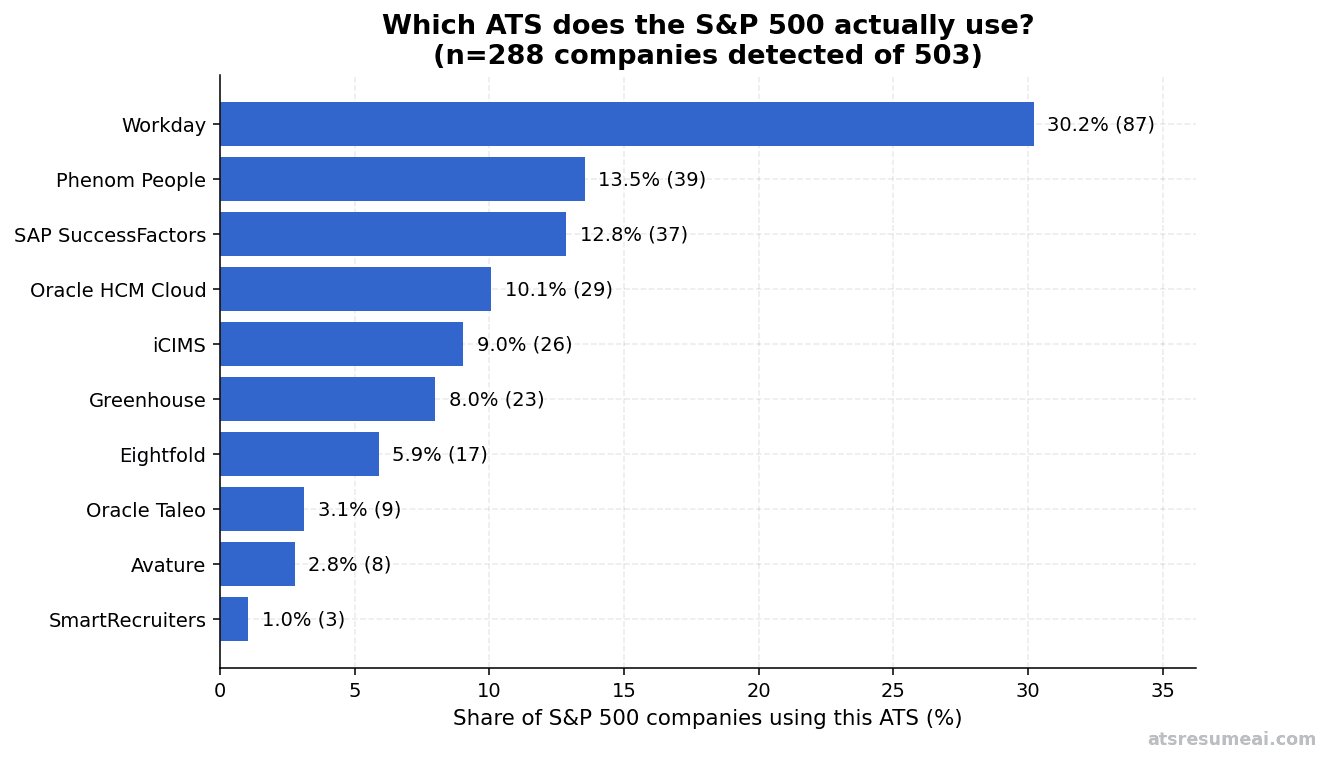
Among the 288 companies where we could identify the ATS:
The table below pairs each ATS with the resume-tailoring advice that's actually specific to that ATS's parser — not generic "use keywords" advice, but what each parser breaks on or rewards. The advice is informed by the live job postings in our dataset plus public documentation each vendor publishes on resume parsing.
| ATS | Share of S&P 500 | What to do on your resume (specific to this ATS) |
|---|---|---|
| Workday | 30.2% (87) | Skip tables and multi-column layouts — Workday's parser duplicates and reorders cells. Use plain headers ("Experience", not "My Journey"). Upload .docx over PDF for cleanest parsing. |
| Phenom People | 13.5% (39) | UI layer on top of Workday/Oracle. Apply the underlying ATS's tips (likely Workday). |
| SAP SuccessFactors | 12.8% (37) | Strictest big ATS on layout. Single column, standard headings, no graphics, no skill bars, no text boxes. |
| Oracle HCM Cloud | 10.1% (29) | Submit .docx rather than PDF — Oracle's PDF parser is the weakest of the major ATSes. Plain section headers only. |
| iCIMS | 9.0% (26) | Mirror the JD's exact phrasing. iCIMS weights substring matches heavily; "stakeholder management" and "managed stakeholders" don't score equally. |
| Greenhouse | 8.0% (23) | Most forgiving on formatting. Optimize for keyword density and JD phrase mirroring rather than layout safety. |
| Eightfold | 5.9% (17) | AI-driven matching layered over an ATS. Lead with measurable outcomes and named technologies — its embedding model favors specific over generic language. |
| Oracle Taleo | 3.1% (9) | Legacy parser. Treat formatting like you would for SuccessFactors: single column, plain headers, .docx over PDF. |
| Avature | 2.8% (8) | Configurable per-customer parser, so behaviour varies. Default to a Workday-safe resume (single column, plain headers). |
| SmartRecruiters | 1.0% (3) | Modern parser, fairly forgiving. Focus on JD-keyword coverage rather than formatting. |
| Other (Lever, UKG, BambooHR, ADP, Jobvite, IBM Kenexa…) | 3.5% (10) | Lever follows Greenhouse-style behavior; the rest are conservative on formatting. Default to a single-column .docx. |
Read "30.2% (87)" as "30.2% of the 288 detected companies, or 87 companies total."
A few notes on these numbers:
- Phenom People is a candidate-experience and recruitment-marketing platform that is frequently layered on top of an underlying ATS (often Workday or Oracle). When we detected Phenom from the careers site, we couldn't always see what was behind it — the real Workday + Oracle numbers are likely modestly higher than what we report.
- Greenhouse in the S&P 500 is concentrated in younger, tech-forward companies that joined the index relatively recently (Airbnb, Datadog, Palo Alto Networks, Block, Veeva Systems). Greenhouse's actual market share across all US companies is much higher than 8% — it just doesn't dominate the legacy enterprise.
- Oracle's combined footprint (HCM Cloud + Taleo) is 38 companies, about 13% — closer to Workday than people usually realize.
The headline: when you apply to a Fortune-class US company, you have roughly a 1-in-3 chance you're hitting Workday and a 1-in-2 chance you're hitting one of the "enterprise big three." If you've optimized your resume for "an ATS" in the abstract, you've probably optimized it for the wrong one.
Search any of the 503 companies in our standalone ATS Finder. For 17 companies where we collected enough live postings — Datadog, Airbnb, Palantir, Coinbase, and others — we've published full hiring breakdowns with role mix, in-demand skills, and experience requirements pulled from real job descriptions.
Finding 2: ATS varies dramatically by sector
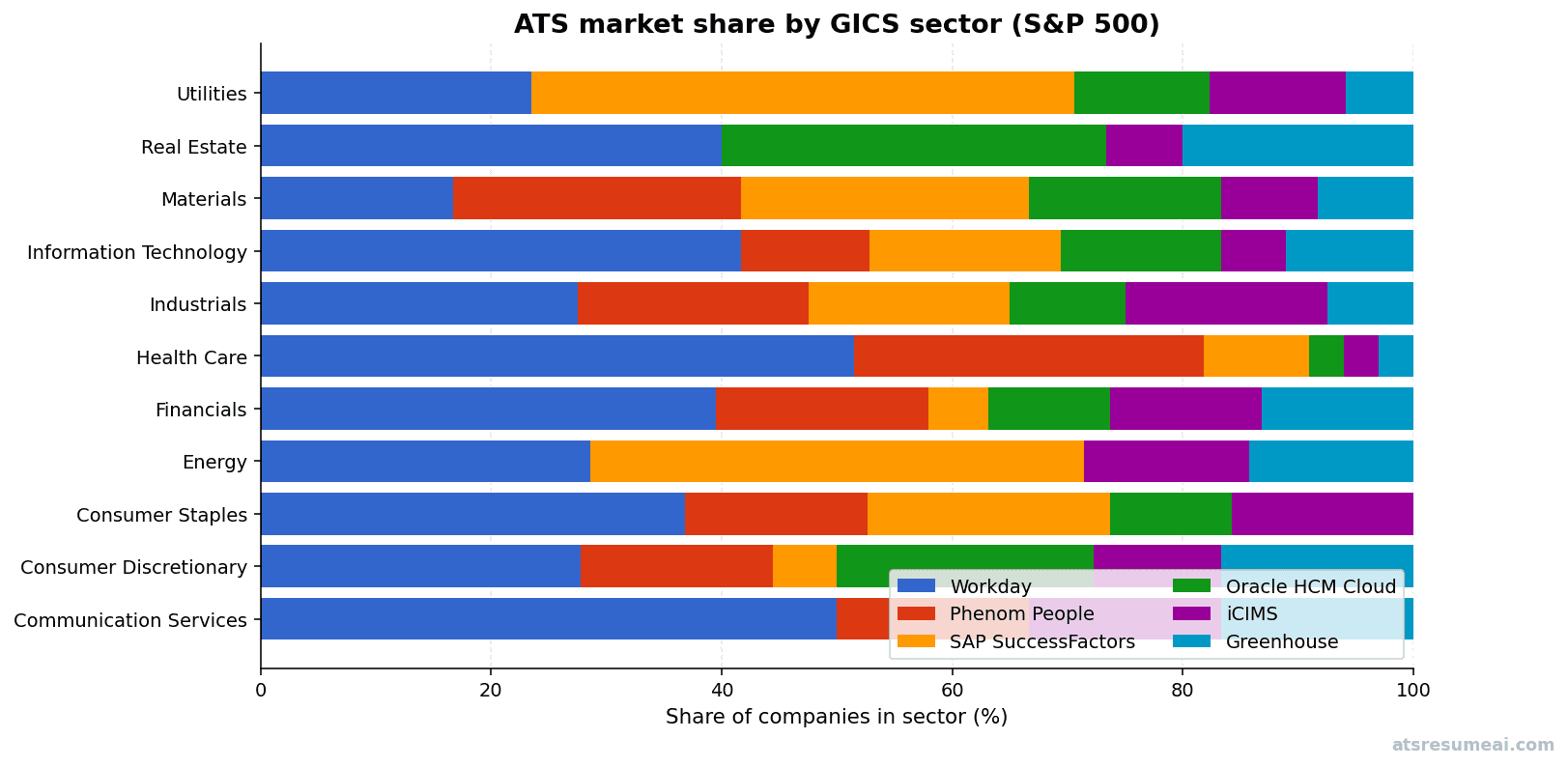
The same resume strategy doesn't work equally well in every industry, because the parser behind the form is different. Dominant ATS by GICS sector, among detected companies:
| Sector | Dominant ATS | Share | n |
|---|---|---|---|
| Utilities | SAP SuccessFactors | 47.1% | 17 |
| Energy | SAP SuccessFactors | 30.0% | 10 |
| Materials | SAP SuccessFactors | 17.6% | 17 |
| Health Care | Workday | 45.9% | 37 |
| Communication Services | Workday | 37.5% | 8 |
| Financials | Workday | 34.9% | 43 |
| Consumer Staples | Workday | 33.3% | 21 |
| Information Technology | Workday | 32.6% | 46 |
| Real Estate | Workday | 31.6% | 19 |
| Industrials | Workday | 22.9% | 48 |
| Consumer Discretionary | Workday | 22.7% | 22 |
Interpretation:
- If you're applying to utilities or energy companies, your resume is going through SAP SuccessFactors more often than not. SuccessFactors is notoriously strict on tables, multi-column layouts, and atypical section headers — keep both very plain. (See our ATS formatting guide.)
- Health Care has the highest single-vendor concentration of any sector (46% Workday). Tailoring once for Workday gets you most of the way through your applications. We wrote a Workday-specific resume guide for this exact reason.
- Information Technology is the most fragmented — Workday, Greenhouse, Phenom, iCIMS, and SuccessFactors all hold meaningful share. Tech job seekers benefit most from checking the ATS per application.
Finding 3: Most JDs don't explicitly require a degree
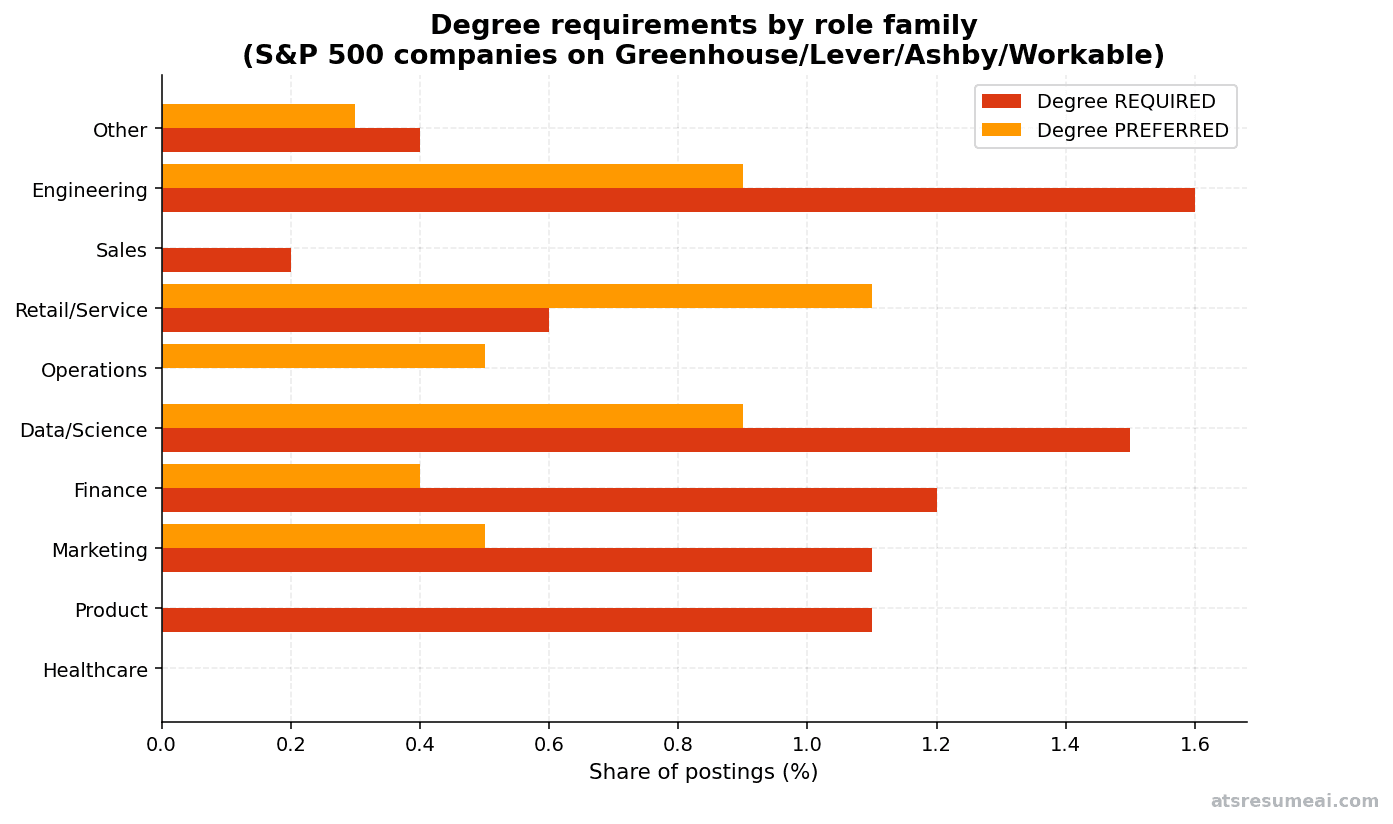
Across 4,547 job descriptions with full content (Greenhouse + Lever postings), we measured how often a posting contains an explicit "required" or "must have" attached to a degree phrase:
| Role family | n | Explicitly required | Preferred | Mentioned anywhere |
|---|---|---|---|---|
| Engineering | 1,639 | 1.6% | 0.9% | 12.7% |
| Data / Science | 332 | 1.5% | 0.9% | 14.8% |
| Finance | 256 | 1.2% | 0.4% | 20.3% |
| Product | 175 | 1.1% | 0.0% | 13.7% |
| Marketing | 185 | 1.1% | 0.5% | 9.2% |
| HR / People | 107 | 0.9% | 0.9% | 13.1% |
| Sales | 1,091 | 0.2% | 0.0% | 8.9% |
| Customer Support | 95 | 0.0% | 0.0% | 6.3% |
| Healthcare (clinical) | 144 | 0.0% | 0.0% | 0.0% |
The honest read: the "you need a bachelor's to apply" filter has been quietly softened in written job descriptions at this scale. Most postings list a degree as one of several qualifications without ever stating it's required. Healthcare roles bypass the degree-mention entirely, screening on credentials like RN/LVN/MD instead.
This doesn't mean ATSes don't auto-filter on degree — many do, and many recruiters add the filter manually as a screening rule even when the JD doesn't say so. But if you've been self-rejecting because you assume every posting demands a degree, the actual written demand is more nuanced.
Finding 4: Median experience demands by role
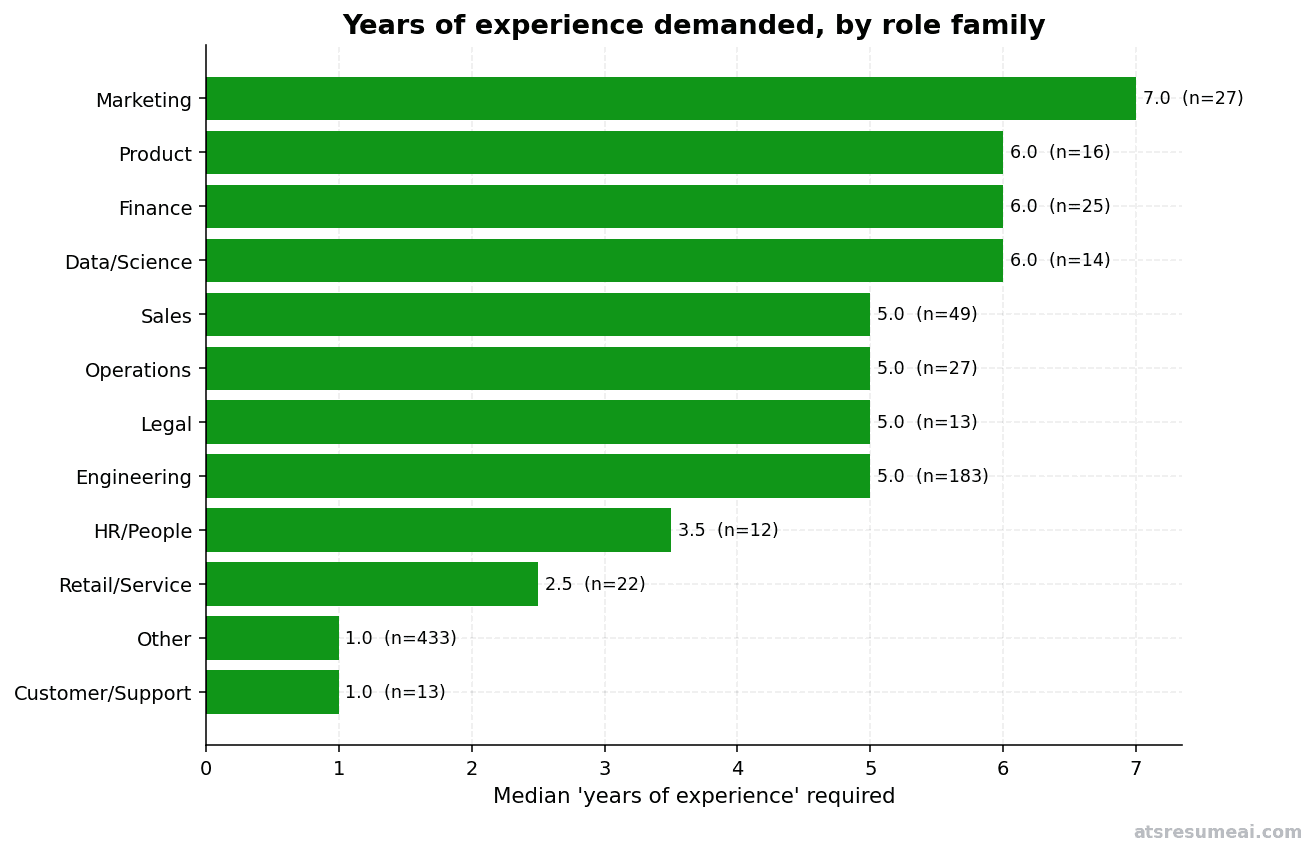
For postings that contain an explicit "N+ years of experience" (extractable n=833), the median demand by role family:
| Role family | Median YOE | n |
|---|---|---|
| Marketing | 7.0 | 27 |
| Product | 6.0 | 16 |
| Finance | 6.0 | 25 |
| Data / Science | 6.0 | 14 |
| Engineering | 5.0 | 183 |
| Sales | 5.0 | 49 |
| Operations | 5.0 | 27 |
| Legal | 5.0 | 13 |
| HR / People | 3.5 | 12 |
| Retail / Service | 2.5 | 22 |
| Customer Support | 1.0 | 13 |
Marketing demanding 7 years on average — more than engineering — is the headline. The S&P 500 hires senior marketing roles disproportionately on Greenhouse and Lever (early-career marketing is typically internal pipelines or staffing agencies, not posted on public boards), which skews the visible postings older.
Finding 5: Remote/hybrid by role
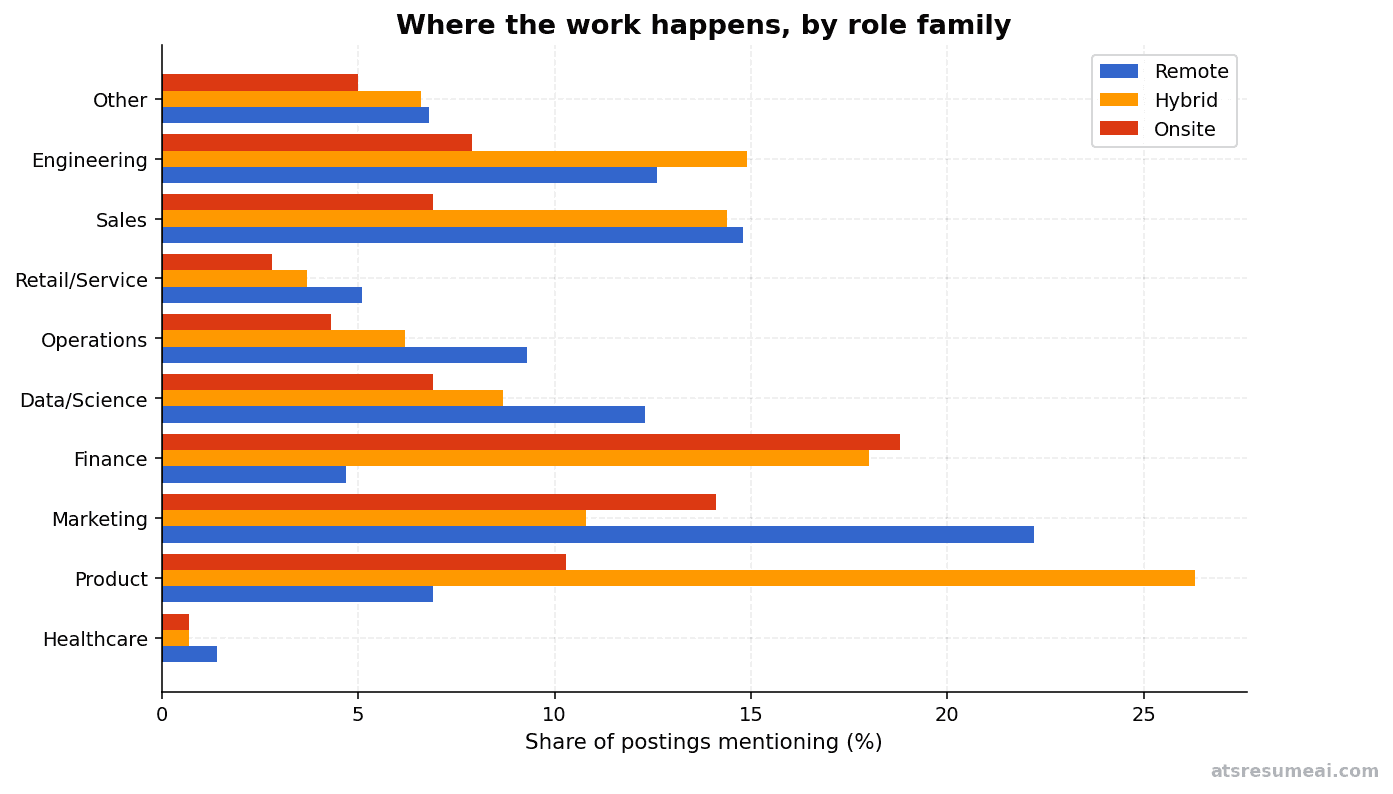
Among 9,260 postings, the share that explicitly mention each work model:
| Role family | Remote | Hybrid | Onsite |
|---|---|---|---|
| Marketing | 22.2% | 10.8% | 14.1% |
| Sales | 14.8% | 14.4% | 6.9% |
| Engineering | 12.6% | 14.9% | 7.9% |
| Data / Science | 12.3% | 8.7% | 6.9% |
| Legal | 11.4% | 19.0% | 10.5% |
| Operations | 9.3% | 6.2% | 4.3% |
| Product | 6.9% | 26.3% | 10.3% |
| HR / People | 6.5% | 31.8% | 22.4% |
| Customer Support | 6.3% | 22.1% | 10.5% |
| Retail / Service | 5.1% | 3.7% | 2.8% |
| Finance | 4.7% | 18.0% | 18.8% |
| Healthcare | 1.4% | 0.7% | 0.7% |
Note: many postings don't mention remote/hybrid/onsite explicitly because the location field already specifies a city. These percentages should be read as "the share of postings that flag this model explicitly in the description" — they understate the true mix.
Finding 6: Tech spotlight — what S&P 500 engineering jobs actually ask for
This is the section job seekers should print and tape to their wall.
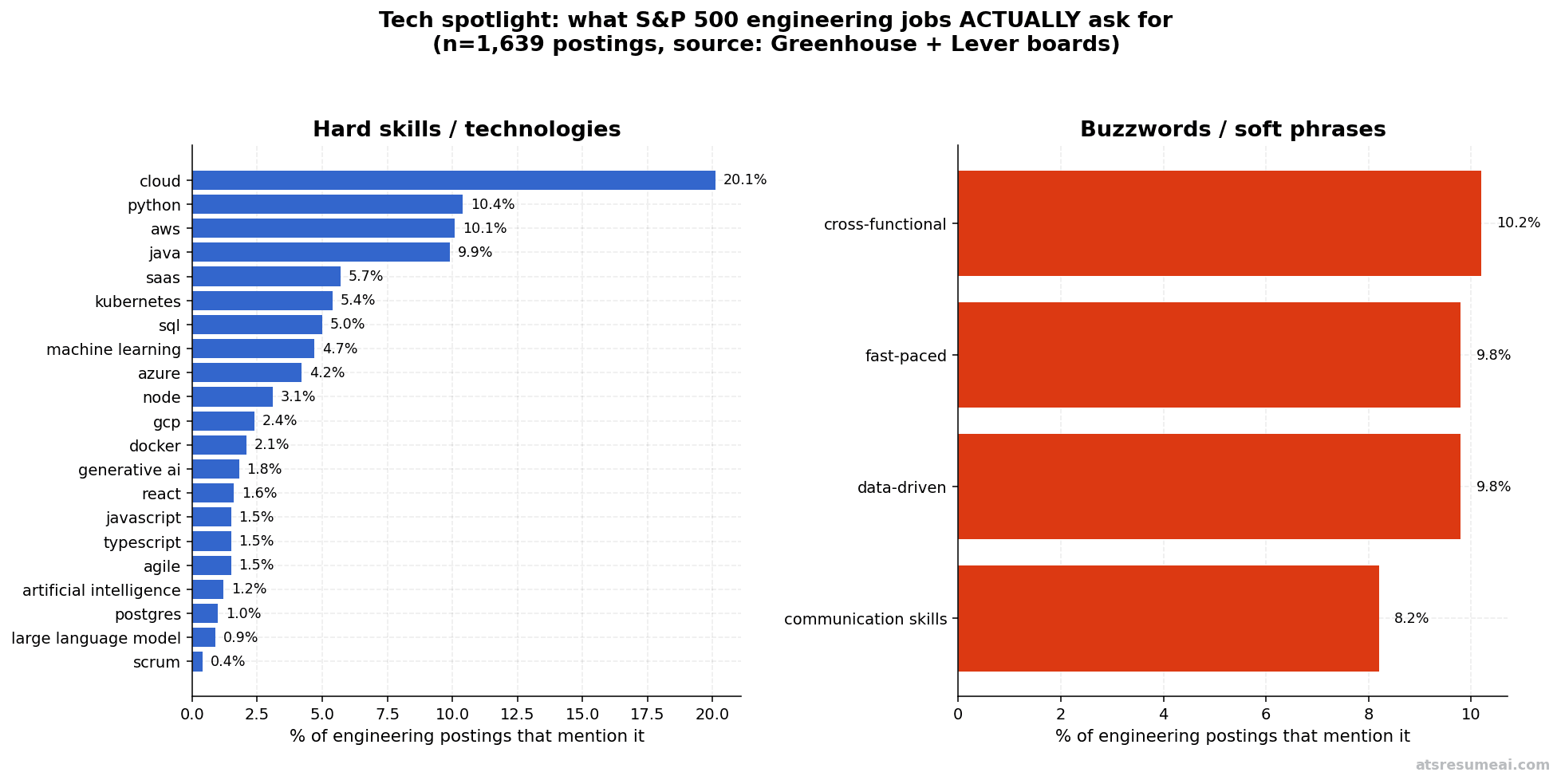
Across 1,639 engineering postings, the share that mention each technology / phrase:
Hard skills:
| Skill | % of engineering JDs |
|---|---|
| "cloud" (any context) | 20.1% |
| Python | 10.4% |
| AWS | 10.1% |
| Java | 9.9% |
| SaaS | 5.7% |
| Kubernetes | 5.4% |
| SQL | 5.0% |
| Machine learning | 4.7% |
| Azure | 4.2% |
| Node.js | 3.1% |
| GCP | 2.4% |
| Docker | 2.1% |
| Generative AI | 1.8% |
| React | 1.6% |
| JavaScript | 1.5% |
| TypeScript | 1.5% |
| Agile | 1.5% |
| Artificial intelligence | 1.2% |
| Postgres | 1.0% |
| Large language model | 0.9% |
| Scrum | 0.4% |
Counter-intuitive observations:
- AWS dominance is enormous, and Azure is not catching up. AWS appears in 2.5× more engineering JDs than Azure and 4.2× more than GCP, even among non-tech S&P 500 companies.
- Generative AI is not in the JDs yet. Despite every CEO press release about AI transformation, "generative AI" appears in only 1.8% of engineering postings; "large language model" in under 1%. If your resume is heavy on LLM keywords for non-AI-specialist roles, you're optimizing for a phantom demand.
- JavaScript and React are radically under-represented compared to the impression you'd get from r/cscareerquestions. The S&P 500 engineering org is mostly backend (Java/Python) + cloud (AWS) + databases (SQL). Frontend specialists are a small slice of the visible demand at this scale.
- Python pulls slightly ahead of Java (10.4% vs 9.9%) — Java is far from dead at the Fortune 500.
- "Cloud" is the single most common technology word in S&P 500 engineering descriptions. Whatever your specific stack, naming the cloud you work in matters.
Buzzwords / soft language:
| Phrase | % of engineering JDs |
|---|---|
| "cross-functional" | 10.2% |
| "fast-paced" | 9.8% |
| "data-driven" | 9.8% |
| "communication skills" | 8.2% |
| "problem-solving" | 4.0% |
| "self-starter" | 1.3% |
If you're mirroring JD language on your resume (which is the standard ATS-keyword optimization advice — and it's correct, see our keyword guide), those four phrases are the highest-leverage soft-language ones to consider including. They show up in roughly 1 of every 10 S&P 500 engineering postings.
What this means for your resume
Three practical takeaways:
- Before you apply, identify the ATS. Look at the URL of the apply form.
myworkdayjobs.comis Workday,boards.greenhouse.iois Greenhouse,*.icims.comis iCIMS,*.taleo.netis Oracle Taleo,*.successfactors.comis SAP,*.smartrecruiters.comis SmartRecruiters. Each parses your resume differently. Workday and SAP SuccessFactors penalize tables and multi-column layouts hardest. Greenhouse is the most forgiving. Tailor your resume file format accordingly. - Mirror the JD's exact phrasing. Most ATSes use a hybrid of substring matching and semantic similarity. If the JD says "stakeholder management" and you wrote "managed stakeholders," some systems score those materially differently. Use the keyword extractor in our ATS resume optimizer to pull the JD's exact terms.
- Don't over-rotate on AI buzzwords for non-AI roles. The data shows S&P 500 engineering postings are still asking for cloud, Python, AWS, SQL, and Java more than for LLMs. Lead your resume with what JDs actually ask for, then mention AI/ML if it's in your background.
Raw data and reproduce yourself
We're publishing the full dataset and methodology so you can verify, replicate, or correct anything in this post:
- Companies + ATS classification (503 rows, 70 KB): download CSV
- Job postings (9,260 rows, 19 MB): download CSV
- Findings JSON (machine-readable analysis output): download JSON
- All seven charts as PNGs: 01 · 02 · 03 · 04 · 05 · 06 · 07


Methodology corrections welcome — open an issue or drop us a note and we'll update the post with a credit.
FAQ
Frequently asked questions
- How was the ATS detected for each company?
- We fetched the careers page, followed redirects, parsed embedded iframes/scripts, and ran roughly 30 regex patterns against the resulting URL plus body to identify well-known ATS vendor signatures. For companies that didn't match on the page, we probed the public board APIs of Greenhouse, Lever, Ashby, and Workable with likely tenant slugs — a positive 200 response with a valid jobs payload is a definitive identification.
- Why is your detection rate only 57%?
- The remaining 43% use single-page-app (SPA) careers sites that load the ATS via async JavaScript. We ran static HTML fetches only. A headless-browser pass (Playwright) would push detection significantly higher; we plan a follow-up that does this.
- Why is your job-posting count lower than the company count would imply?
- We pulled from public board APIs only. Workday's list endpoint returns more than 6,000 live postings across the 87 Workday companies we found, but the title-only payload meant we couldn't analyze description content for those. Greenhouse and Lever return full content, giving us 2,905 postings with description-level analysis. The full-content jobs power our keyword / years-of-experience / degree analyses; the full set of 9,260 is used for role-family and location analysis.
- Is this representative of the whole US job market?
- No. The S&P 500 is the largest publicly listed US companies. Smaller employers and startups tilt heavily toward Greenhouse, Lever, Ashby, and Workable and will produce different ATS share numbers. We chose the S&P 500 because it's a defined, replicable universe with a fixed roster.
- How do I use this to actually land more interviews?
- Pick the ATS you're applying through, tailor your resume to it (our free ATS audit tells you exactly which JD keywords you're missing), and mirror the language that the JD actually uses — which the tables above quantify.